



Sandy Grossman
Hear it here!
Let me start by defining the director of a sports telecast as the one who is in charge of putting the pictures on the air when we watch a game. He has meetings with the cameramen in advance, who know their specific responsibilities and when the game begins, it’s all fly by the seat of your pants. It’s unscripted and quick decisions, over a thousand during the contest, is what covering an event is all about.
I’ve told those who would want to sit in the booth and see how announcers work during a game that they’d be far more captivated watching how the producer and director work in the production truck down below, near the entrance to the building outside the stadium or arena with the big wall of TV screens, called monitors, dominating the room.
Sandy Grossman was one of the most distinguished directors in television sports history.
He directed 10 Super Bowls, 18 NBA Finals, 5 Stanley Cup Finals, plus several Olympics. He won eight Emmy Awards for his directing. He died in April of 2014, at the age of 79. He spent his career with CBS and Fox Sports.
There was a time I dreamed of working with him at both networks. But Sandy was the lead director in everything he did and I hadn’t yet climbed that high. For 21 years he was the director for Pat Summerall and John Madden at CBS and Fox, and was the behind-the-scenes magician that made Madden an iconic football expert-analyst that stands alone in NFL broadcasting annals. It was Sandy Grossman who was able to give Madden the pictures that made John a one-of-a-kind broadcaster. Madden credits Sandy for being the first director to widen the camera shot to include outside linebackers, which showed in its entirety, how the great Lawrence Taylor, still regarded as the best defensive player of all-time, would either rush the quarterback, or fall back in coverage, and make the plays that made Taylor a one-of-a-kind star.
Said Madden, “Sandy became like a defensive coordinator, the way he looked at stuff. He had a plan for everything, and when it happens, boom, boom, boom, you’re right there. Sandy took the knowledge he got from the film and transferred it to the cameramen, who carried it over to the game”.
When CBS acquired the rights to the NBA after decades of coverage by ABC, Sandy was the chief director.
He worked with Red Auerbach, the legendary Boston Celtics coach for a CBS show, “Red on Roundball” which helped viewers understand the nuances of the NBA game they were watching. It was similar to what he did with Madden in football. He made pro basketball come alive. Eventually the time came when I finally fulfilled my dream and got to work with Sandy. I became the lead announcer for the NBA starting with the 1982-83 season and continued right through until 1990. NBC assumed the rights the following year. It was a golden era for the league.
Julius Erving finally led the 76ers to a world championship. His intense rivalry with Larry Bird and the Celtics was at its peak and then came the storybook Celtics-Lakers championship duels, with Bird and Magic Johnson in the spotlight. The arrival of the greatest player I’ve ever seen, Michael Jordan, his development and the Bulls challenge to overcome the next dominant team, the Detroit Pistons, the Bad Boys, who captured the last two Finals in our time covering the league, a magical period I was fortunate to cover with Sandy Grossman calling the shots.
Sandy advanced sports directing at that time in several ways. He became adept at finding the right reaction shot after a basket or an important play. Instead of showing knee-jerk crowd shots (people in the stands who were watching what you at home wanted to see), he would capture a smile, a frown, an elation or a dejection from a player in the game or on the bench, or a coach, whatever, to add to the emotion of the battle on the floor.
Earlier in his career, he was the first to utilize music going to commercials. There were so many added elements to a Sandy Grossman telecast that actually made a game even bigger than it was.
He simply had the touch. And he was an unselfish person. He would gladly give advice to a young director if asked.
Bob Fishman, a Hall of Famer like Sandy, who succeeded Grossman as the network’s elite director, credits Grossman with helping him to become a legend in his own right.
Perhaps by now you might be wondering why Sandy Grossman is the subject of this week’s effort.
On August 7, Sandy Grossman will enter Pro Football’s Hall of Fame in Canton, Ohio as this year’s winner of the Pete Rozelle Award named after the sport’s greatest Commissioner, and given to someone in broadcasting who distinguished himself beyond the call in his career covering the NFL.
It’s long overdue, but it’s welcome and deserving. Sandy’s son Dean, a high-level sports agent had fought for years to have his father’s vast gridiron TV achievements recognized at the highest level.
Just think for a moment how difficult it is for someone to be lauded posthumously. Years have passed since a talent like Sandy was in the trenches. Now more years are tacked on after his retirement. More years after his passing.
Meanwhile, others more current are still active and fresh in the minds of those who decide such honors. To roll back the years and select someone who is no longer front and center is not easy. But for those who care, like his son Dean, and perhaps others who he touched, it means everything.
So on August 7th in Canton, Ohio, those attending NFL’s Hall of Fame weekend will hear about the exploits of a television director who made the careers of so many who played, including those who are being inducted in this year’s class, come alive, sometimes larger than life.
And when that happens, Sandy Grossman will be looking down and smiling. Which is the way those of us who knew him and worked with him, remember him.
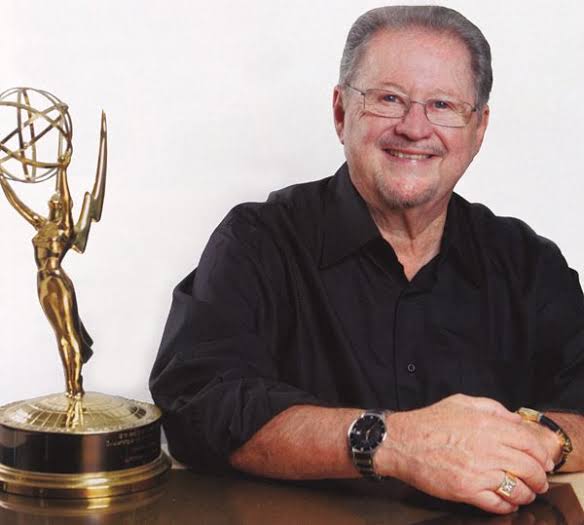
With one of his Emmys
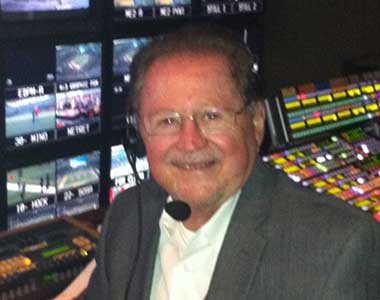
At work with the walls of monitors
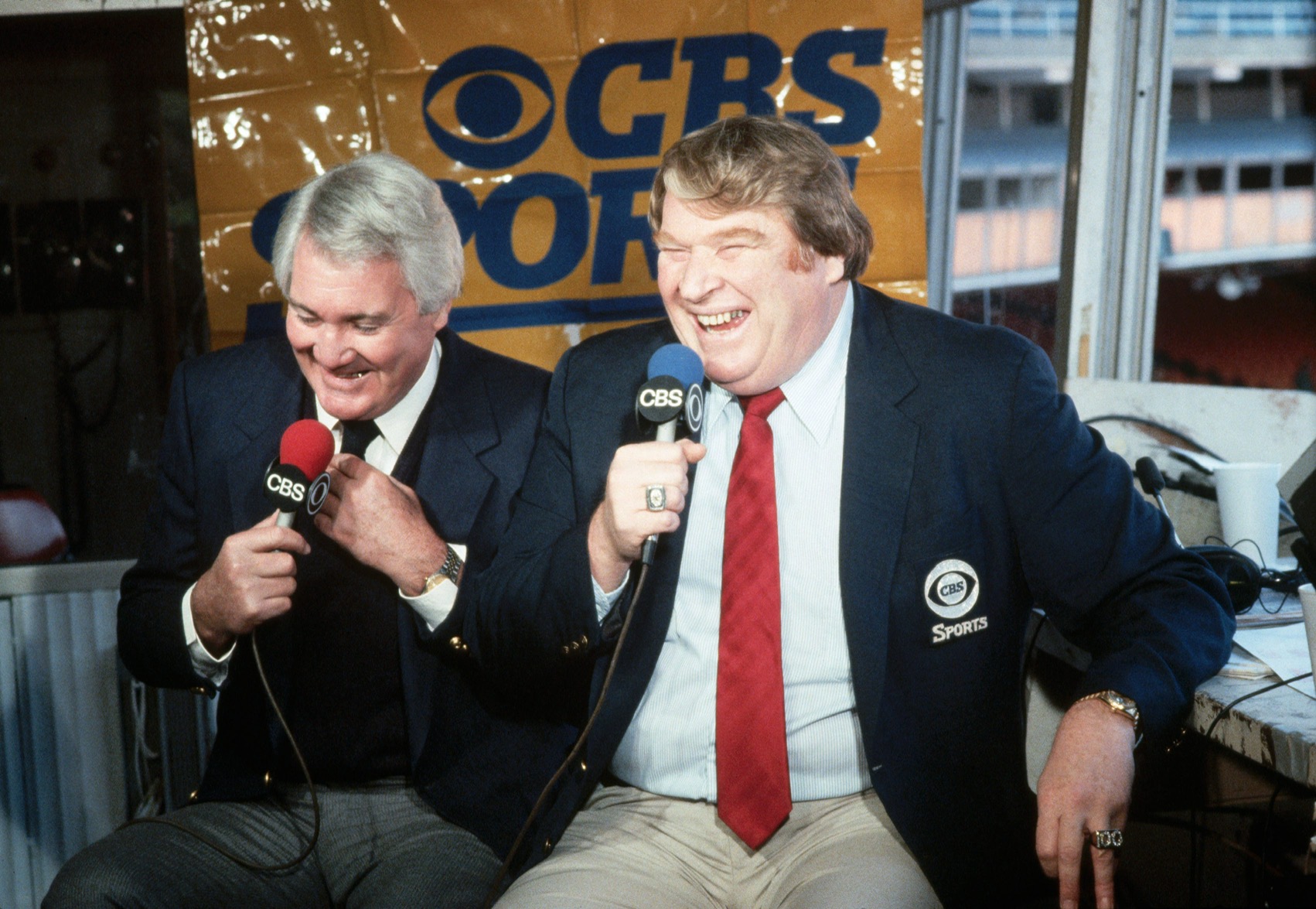
21 years with Pat and John

